Chapter Five – The Weight of Survival
When I was seven, I fell from a second-story ledge and landed hard, seated directly onto the concrete below. I was hurt, but instead of comfort or concern, my mother spanked me. Her reasoning? I had disobeyed her by going up the stairs. That moment, both physically and emotionally, marked the beginning of a long season of feeling like no matter what I did — right or wrong — I was on my own and was always the one taking the blame.
Growing up, I was the only girl in a family where emotional connection was already scarce. My brothers never included me in anything they did. I was constantly left out, excluded, and unseen. I remember quietly wishing, many times, that I hadn’t been born a girl — thinking that maybe then, I would have been included. Maybe then, I wouldn’t feel so alone.
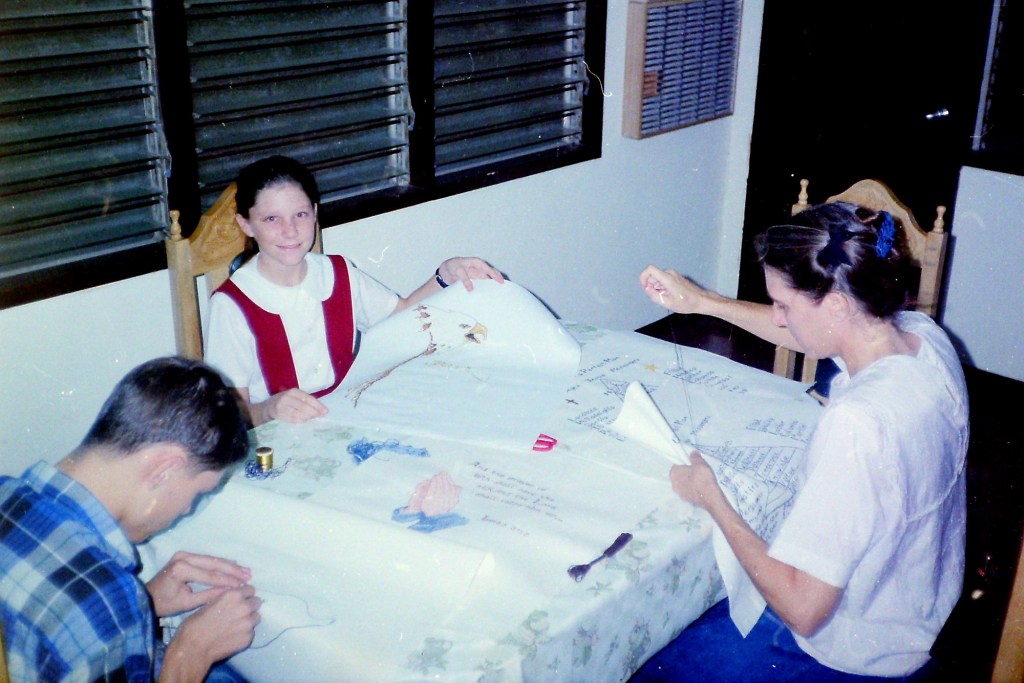
There was no childhood for me. Not in the carefree sense. My childhood was consumed with adult burdens: making crafts, surviving, and watching my mother carry the weight of our entire family while my father, convinced the Rapture was coming soon, refused to work. He told us it didn’t matter — that we’d be gone before we knew it and God would provide. So we begged, borrowed, and relied on the relentless labor of my mother, even though I was taught women weren’t to work and the husband was to be the provider. The rules didn’t apply to my father.
We spent six years in Puro Beach before we found out that the land we had built our home on was never legally ours. The man we paid had died of a rare foot disease, and the title belonged to someone else. We had to tear our hut down, piece by piece, sell off the materials, and move. We ended up renting a room from a woman who grew orchids. My mother, still devoted to her faith, quickly pulled the neighbors into the Message belief system. We only lived there for a few months before moving again, this time to a two-story house just two blocks away. Soon, our home was once again a church. We opened our doors to the neighbors — Mercy and her family — and resumed holding services in our living room.
After I graduated from sixth grade, we moved to Albay, where I took the entire next school year off. That was when Josh left to work with the Voice of God headquarters in Manila and visited Mindanao. He returned and told my father about it, and just like that, we were packing again — this time for a completely different part of the Philippines.
I never learned how to form lasting friendships. I adapted easily, but I never attached. Every move required me to let go of people I had just started to trust, and I learned to expect the goodbyes before the hellos even had time to root. There was never room to settle.
Through it all, the only stability I found was in my faith. From the time I learned to read, I read my Bible daily and prayed constantly. I leaned on God because I had no one else to lean on. I always wished I had a sister — someone to confide in, someone who could be my friend no matter where we moved. My mother was too overwhelmed to give me attention. I carried my loneliness like a second skin.
One January, in Puro Beach, I remember praying in my room with childlike faith: “My mother will get pregnant on February 26th and have a little girl.” She did get pregnant — on that exact day. But five months later, she miscarried while lifting the couch to clean under it. The baby was a girl. The midwife confirmed it. It was a strange moment of both confirmation and sorrow. I took it as a sign that God heard me, but also that He knew my mother couldn’t have handled another child — not in that environment.
My father never lifted a finger to help my mother — just like the man I would later marry. She carried groceries up steep hills by herself. I carried two-gallon jugs of water from the community well, half a mile away, up to the house. She had three miscarriages from stress and exhaustion alone. And years later, I would see my own marriage mirror hers — except mine would also include physical abuse.
But not everything in the Philippines was hardship. The final year we spent there was a brief, unexpected gift. We moved into a rental unit attached to someone else’s house — paid for by a family in the Message. I began my first year of high school (seventh grade in the Philippines), and for the first time in my life, I had food security. A woman from our church named Remie gave me money every week so I could buy food at school. For someone who had gone 8.5 years being malnourished and hungry, that simple act meant everything. It was the first time I was taken care of by someone who wasn’t even family. She will forever hold a place in my heart for what she did for me.
Then came the accident.
I was twelve. A sister from the church washed our laundry for us and dried it on the roof of her family’s shop. One day, I realized I had forgotten to bring home my school uniform the day before. I rushed to get it, out onto the roof— not realizing there was a thin plastic skylight in the center of the tin. I stepped on it. It gave way.
I fell two stories, landing on a metal bar and crashing down hard on my right arm and hip. My wrist bone was pushed completely out of place. Instead of going to the hospital, I was taken to an herbal “healer” who massaged it and tried to realign it. A week later, I fell again at school and the pain became unbearable. They finally took me to a doctor who had to put me under anesthesia, re-break the bone, and cast it for two months.
I couldn’t walk for three weeks because of the pain in my hip. But I was never examined for hip trauma, and the injury haunted me for 14 years. My back, hip, and neck were in constant pain. I spent thousands of dollars in my adult life on chiropractors and massage therapists just trying to find relief. There were times when I was bedridden for an entire week.
Of course, my father told me I didn’t need to see a doctor. He laid hands on me and declared I was healed, that I just needed faith. My parents neglect cost me years of suffering.
I would later realize that a large part of that pain wasn’t just physical — it was emotional. It was stress. It was being raised in a home where survival was expected, but emotional support was absent. It was the burden of secrets and gaslighting and fear. I wrote Dr. Phil once, asking if he’d put my family on his show. His team responded. They wanted to do it. But I never followed through. I wasn’t ready to open that door.
Not yet.
Our escape from the Philippines came through my grandfather, who loaned us money to start over in the U.S.—a house, a gutter machine, a truck for the business. Josh took credit for all of it, claiming we’d still be stuck in the Philippines if he hadn’t contacted my grandfather. But deep down, I sometimes wished I’d stayed. Because in leaving, I was walking straight into 17 more years of suffering under the same religious mentality—just dressed in a different form.



 The Return To Wholeness
Leave a comment